Manufacturers are under constant pressure to increase production, maintain consistent quality, control costs, and respond quickly to changing demand. At the same time, labor shortages and increasingly complex production requirements are pushing companies to rethink how work gets done on the factory floor.
Robotic automation in manufacturing has become an important part of that shift. By using robotic systems for repetitive, precise, and physically demanding tasks, manufacturers can improve production consistency while allowing employees to focus on responsibilities that require technical knowledge, decision-making, and problem-solving.
From assembly and machine tending to inspection and packaging, robotic systems can be adapted to a wide range of production environments. The goal is not simply to make machines work faster, but to create production processes that are more consistent, efficient, and easier to scale.
Why manufacturers are turning to robotics
One of the biggest advantages of robotic automation in manufacturing is its ability to perform repetitive processes with consistent precision. Robots can repeat the same movement thousands of times without fatigue, helping manufacturers maintain predictable production cycles.
This is particularly valuable for tasks such as picking components, positioning parts, fastening products, welding, painting, and packaging. When these processes are automated, employees can spend less time on repetitive movements and more time supervising operations, managing quality, or handling more complex responsibilities.
Automation can also help manufacturers respond to changing demand. Instead of relying exclusively on additional labor to increase production capacity, companies can use robotic systems to improve the productivity of existing operations.
For many facilities, robotic automation in manufacturing also provides the flexibility needed to adjust production volumes without completely restructuring existing workflows.
Improving production speed and quality
Production speed and consistency are closely connected. Increasing output is only valuable when products continue to meet established quality standards.
With robotic automation in manufacturing, production tasks can be completed at controlled speeds while maintaining repeatable movements and positioning. This can help reduce variations that may occur during manual processes and create more predictable production cycles.
Shorter production cycles
Manual processes can be affected by fatigue, inconsistent cycle times, and interruptions. Robotic systems can perform designated tasks continuously and at a consistent pace, helping reduce bottlenecks within production lines.
Shorter cycle times can increase throughput and allow manufacturers to meet higher order volumes without making major changes to their existing processes. This can be particularly useful for facilities where production demand fluctuates throughout the year.
More consistent output
Quality is another area where robotic automation in manufacturing can make a measurable difference. Robots can perform repetitive movements with a high level of precision, reducing variations that may lead to defects or rework.
For manufacturers producing large quantities of the same product, this consistency can help reduce waste while making quality control easier to manage. Consistent processes can also make it easier to identify problems when something falls outside established production standards.

Reducing manufacturing costs
The financial benefits of robotic automation in manufacturing extend beyond labor savings. More consistent production can reduce material waste, minimize rework, and improve the use of equipment and production space.
Although purchasing and integrating robotic equipment requires an initial investment, manufacturers should evaluate the long-term value of automation rather than focusing exclusively on the upfront cost.
A robotic system that increases throughput, reduces errors, and allows employees to focus on higher-value activities can create savings across several areas of an operation. For this reason, manufacturers should consider productivity and operational improvements when calculating the potential return on investment.
Making better use of labor
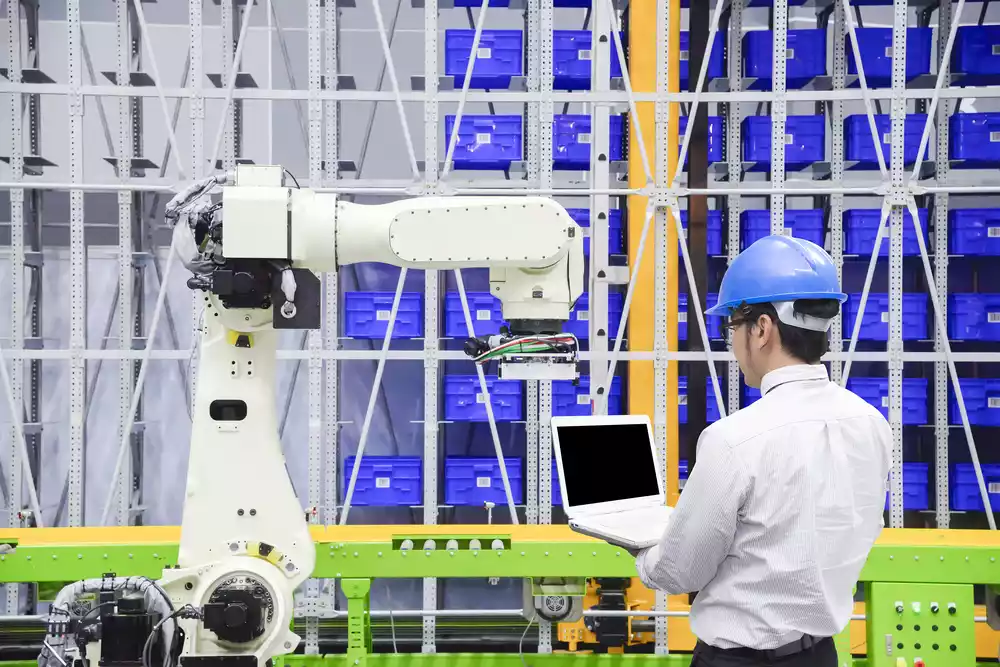
Automation does not necessarily mean eliminating employees. Instead, robotic systems can take over repetitive tasks while workers move into roles involving machine supervision, maintenance, quality control, programming, and other specialized responsibilities.
This can be particularly valuable in facilities where it is difficult to recruit workers for repetitive or physically demanding positions. Employees can develop technical skills that support the automated equipment while continuing to play an important role in production.
Reducing material waste
Precision can also contribute directly to cost control. When a robotic system performs a task consistently, there is less variation in processes that could result in damaged components or defective products.
This level of process control makes robotic automation in manufacturing particularly valuable for industries where precision and material efficiency directly affect production costs.
For industries where raw materials represent a significant portion of production expenses, even modest reductions in waste can have an important impact on profitability. Better process control also helps manufacturers use resources more efficiently.
Creating safer work environments
Workplace safety is another reason manufacturers are investing in robotic automation in manufacturing. Production environments may involve heavy loads, repetitive movements, high temperatures, chemicals, or other potentially hazardous conditions.
Robotic systems can perform certain physically demanding or hazardous tasks while employees focus on monitoring, quality assurance, and other responsibilities.
Reducing repetitive physical work
Repetitive movements can contribute to fatigue and physical strain over time. Automating these activities allows employees to spend less time lifting, reaching, positioning, or moving materials throughout a shift.
A more ergonomic workplace can benefit both employees and manufacturers by reducing physical demands and creating more sustainable working conditions.
Automating hazardous applications
Depending on the application, robots can also be used for processes that expose employees to potentially dangerous environments. Creating physical separation between workers and hazardous operations can help improve workplace safety while maintaining production requirements.
For manufacturers evaluating robotic automation in manufacturing, safety should therefore be considered alongside productivity, quality, and financial performance.

Robotic technologies used in manufacturing
Different manufacturing processes require different types of robotic systems. Selecting the right technology depends on the task, production volume, available space, product characteristics, and required level of precision.
Articulated robots
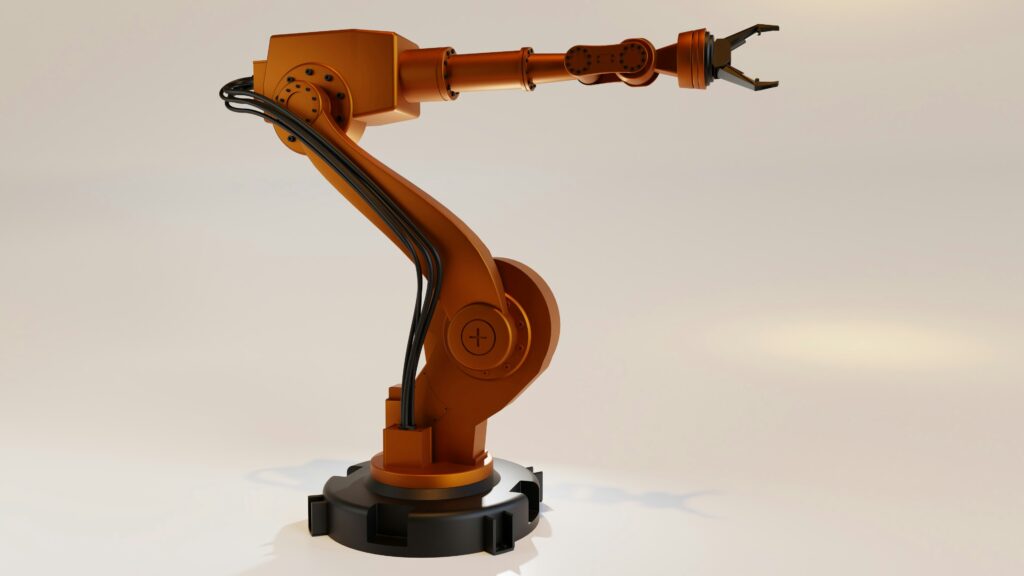
Articulated robots are widely used because their multiple joints provide a broad range of motion. They can perform complex movements and reach different positions within a production cell.
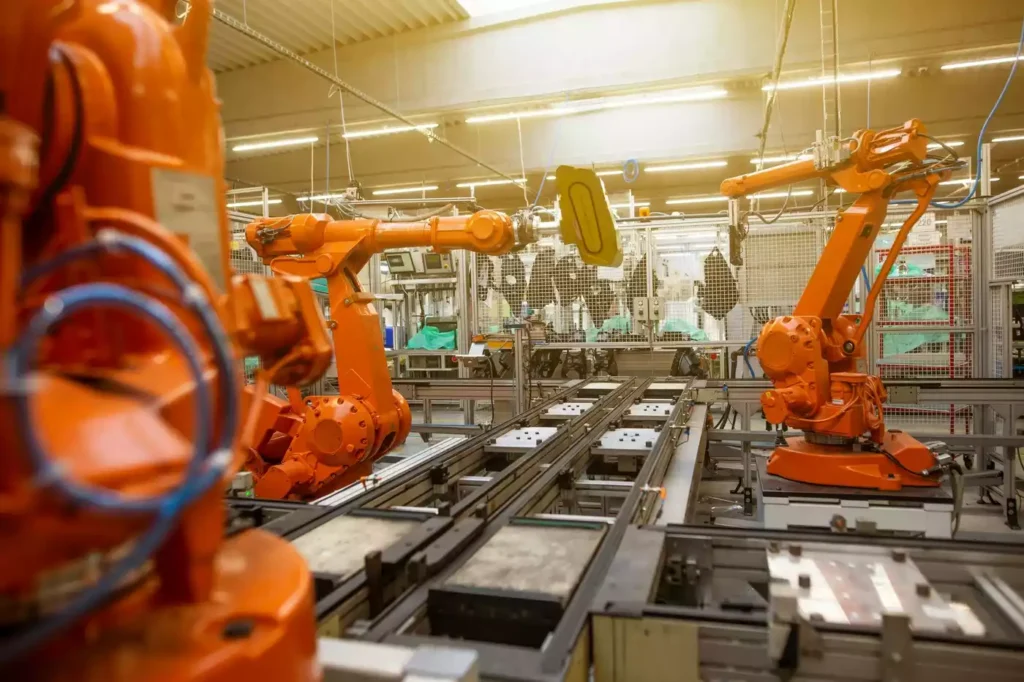
Common applications include welding, painting, assembly, machine tending, and material movement. Their flexibility makes them useful for manufacturing processes that require precise positioning and repeatable movements.
Collaborative robots
Collaborative robots, commonly known as cobots, are designed to work more closely with human employees than many traditional industrial robots. This makes them useful for applications where automation and human expertise need to operate within the same workflow.
Cobots can support assembly, machine tending, inspection, packaging, and component handling. Their flexibility has made them an increasingly relevant option for robotic automation in manufacturing, particularly for companies looking to automate individual processes without completely redesigning their production environment.
Software, sensors, and AI
Robotic systems are becoming more capable because of improvements in software, sensors, machine vision, and artificial intelligence.
These technologies allow robots to gather information about their surroundings, communicate with other equipment, and respond to changes within a production process. Machine vision, for example, can help robotic systems identify components or inspect products during production.
Data collected from automated equipment can also help manufacturers monitor cycle times, identify bottlenecks, and determine where additional improvements may be possible. This makes robotic automation in manufacturing part of a broader strategy for improving production visibility and decision-making.
Planning a successful automation project
Automation can provide significant benefits, but successful implementation requires careful planning. Manufacturers need to evaluate the task they want to automate, the expected return on investment, available workspace, safety requirements, and how the technology will interact with existing equipment.
The initial cost is one consideration, but it should be evaluated alongside expected improvements in productivity, quality, labor allocation, and operating expenses. A clear assessment can help companies determine whether a particular automation project supports their long-term goals.
Employee training is another important factor. Workers may need to learn how to operate, monitor, troubleshoot, or maintain new robotic systems. Investing in these skills can help companies get more value from their automation investment while giving employees opportunities to move into more technical roles.
A well-planned robotic automation in manufacturing strategy should therefore consider both the technology and the people responsible for operating and supporting it.
Choosing the right application is equally important. Not every task will benefit from automation to the same degree. Repetitive, high-volume, physically demanding, or highly precise processes are often strong candidates.
What comes next for robotic automation in manufacturing
Artificial intelligence, machine vision, connectivity, and improved sensors are expanding what robotic systems can accomplish. As these technologies continue to develop, robots are becoming more adaptable and capable of responding to changing production conditions.
This evolution will make robotic automation in manufacturing increasingly relevant for facilities that need greater flexibility without sacrificing efficiency.
Cobots are particularly promising because they allow manufacturers to introduce automation into processes where traditional robotic cells may not be practical. Their ability to work alongside employees can also make automation easier to incorporate into existing workflows.
The future of manufacturing will not be defined by robots replacing people. Instead, successful operations will increasingly combine human expertise with automated systems that handle repetitive and physically demanding work.
Bringing collaborative automation to your production floor
For manufacturers ready to explore this approach, the right robotic solution should be selected around the specific application rather than simply choosing the most advanced technology available.
AMS, Inc. offers cobot arms designed to help manufacturers automate repetitive and demanding processes while maintaining flexibility on the production floor. These systems can support applications such as assembly, machine tending, material handling, inspection, and other tasks where consistent performance is essential.
For companies evaluating robotic automation in manufacturing, cobot arms can provide a practical way to introduce automation into existing workflows without necessarily requiring a complete production redesign.
The right solution depends on the application, production requirements, workspace, and desired level of automation. By evaluating these factors carefully, manufacturers can create an automation strategy that improves efficiency while keeping their production environment flexible.
With the right technology and implementation strategy, AMS, Inc. can help manufacturers take the next step toward a more efficient, flexible, and productive operation through collaborative automation.